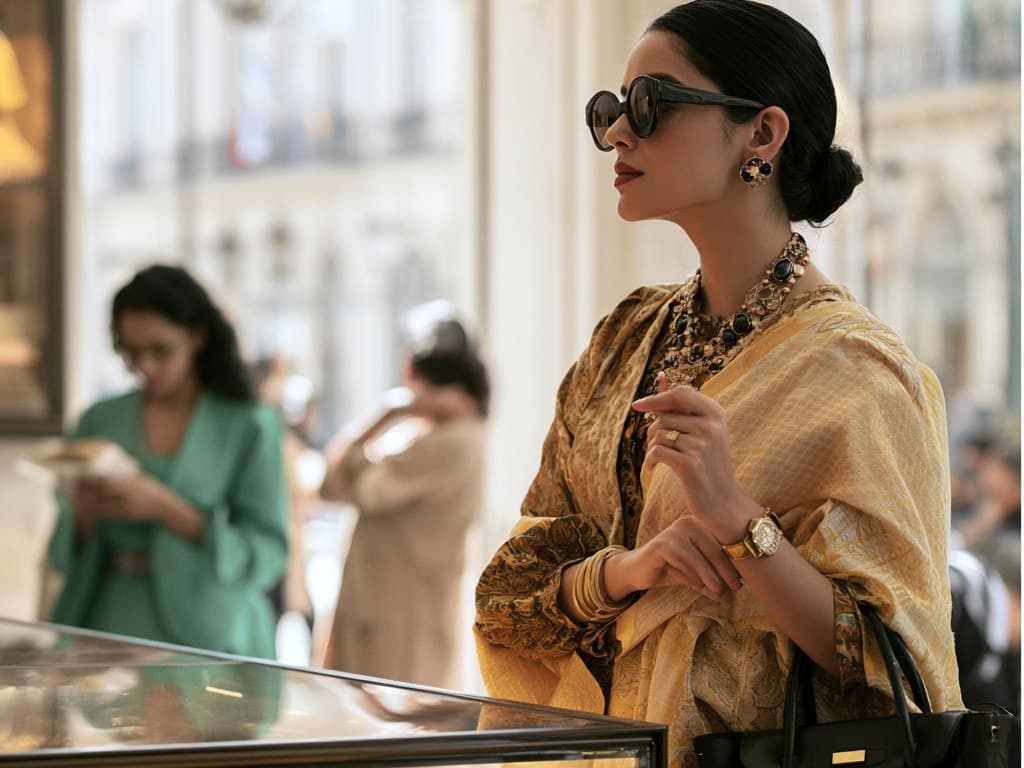
Most women in India own jewellery before they ever choose any. It arrives at weddings, yours or someone else's. It comes down through a mother or a grandmother, sometimes with a story attached and sometimes only with an instruction about which locker it belongs in. It is bought for you at milestones, by people who love you, in gold, and it is understood by everyone involved to be both a gift and a holding of value. The two are never fully separable.
This is not a complaint. It is one of the more generous traditions anywhere in the world, and the jewellery that comes to you this way is often the jewellery you will care about most. But it does mean that for a great many women, the first piece they genuinely chose came late, and the first piece they bought with their own money for no occasion whatsoever may not have come at all.
That gap is worth looking at, because something in it has shifted.
The occasion problem
Ask a woman why she bought a particular piece of jewellery and she will usually answer with an event. A promotion. A birthday, though rarely her own. An anniversary, a Diwali, a return from somewhere. The purchase is justified by the occasion, and the occasion does the emotional work of making the spending acceptable.
This is such a normal way to think that its strangeness only shows up on inspection. We do not require an occasion to buy a good coat, or a decent chair, or the more expensive coffee. Those purchases justify themselves through use. Jewellery, which is worn more days of the year than almost anything else a person owns, somehow does not.
The reason is that jewellery has been coded as either an investment or a gift, and neither category has room for wanting something. Investment requires a rational case. Gifting requires someone else.
Wanting requires only you, which turns out to be the harder thing to admit.
Where the money actually went
The shift is not really about jewellery. It is about who is earning.
A generation of women in Indian cities is now several years into careers that pay them properly, and the spending patterns that follow are visibly different from those of the generation before. Money goes into travel, into rented flats furnished to personal taste, into equipment for hobbies nobody expects them to justify, into skincare with no wedding attached to it. These are all purchases whose only rationale is that the buyer wanted them.
Jewellery has been slower to make that shift, and the reason is price architecture. Fine jewellery in India starts at a number that demands an occasion, because at that number the purchase really is partly financial. Fashion jewellery sits at the other end, cheap enough to require no justification and cheap enough that it rarely feels like a choice. Between the two is a category that has barely existed here: pieces good enough to wear every day for years, priced so that buying one on a Tuesday is not a financial event.
That middle is where self-purchase becomes possible. Not because the jewellery is more meaningful, but because the price stops forcing a story.
The thing nobody says about small luxuries
There is a genre of writing that insists small indulgences are secretly essential, that the expensive candle is really about self-worth, that buying yourself flowers is an act of radical care. It is well meant and mostly untrue, and the strain of it shows.
The honest version is simpler. Some objects are pleasant to own and pleasant to use, and pleasure is a sufficient reason. A pair of earrings you reach for four mornings out of five is not healing anything. It is just good, in the ordinary way that a well made thing is good, and it goes on being good for years.
What is genuinely worth noticing is the decision rather than the object. The first time you buy something with no occasion, no justification and nobody's approval, you find out something about your relationship to your own money. For many women that moment arrives surprisingly late, well after they have become the person the family calls about financial questions.
What changes afterwards
Very little, and that is the point.
Nobody comments. The world does not treat you differently. You wear the piece to work and to dinner and to the chemist, and after a fortnight it stops registering as new and starts registering as yours. In a year it carries a small accumulated history of ordinary days, which is more than most gifted jewellery manages, sitting where it sits.
The pieces people end up loving are almost never the expensive ones. They are the ones that were present.
A note on our own interest here
We make jewellery, so we have an obvious stake in this argument, and it would be poor form to pretend otherwise.
What we would say is that the case does not depend on buying ours. It depends on the far less commercial observation that a great many capable, well paid women are still waiting for permission to spend on themselves, and that the permission is not coming from anywhere except from them.